
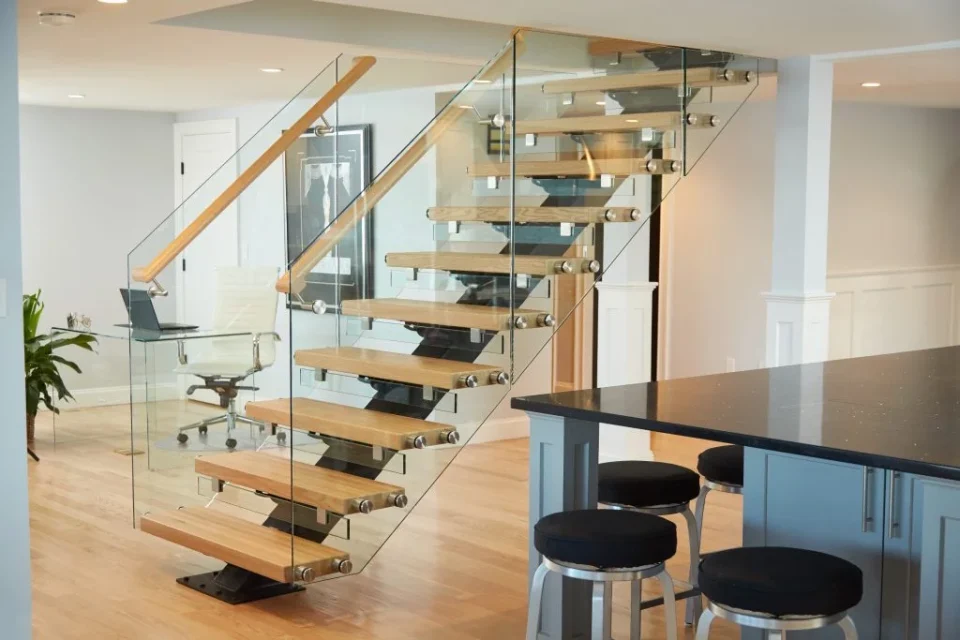
A floating stairway is a series of stairs that appears to be sustained by nothing but air. The stairway’s tread is attached to a hidden metal structure, or even directly to a wall, to ensure that there is nothing obstructing one’s sight. The stairway appears as if it is weightless, and this is exactly what people who reside in open homes desire. Although these stairways appear to be weightless, they can withstand the same weight that other stairways can. Most constructors of these stairways choose to hide them to bring attention to the aesthetic of the stairs.
How a Floating Staircase is Made
It’s a remarkably simple idea, but the construction is quite intricate. The weight-bearing structure is embedded into the wall or the floor prior to finished walls. Then, the tread is attached, and enough is left to hide the fixing. Wood, glass, and metal materials can be used because they can be combined effectively to hide the structure. Other houses incorporate stone tread materials, although this is much heavier and requires additional supports.
Glass balustrades lie along the outside edge to satisfy the safety requirements. The transparent sides enable the staircases to retain their open structure. If a person wishes to have a situation where there is neither a balustrade nor a fence, there is a guideline for distances and the height of the fall. This is, therefore, sometimes not possible. The designer examines all the loads, step dimensions, and distances prior to any construction being carried out.
Why People Prefer This Style
They can help make a house appear larger. Without massive supports that cut across the room, much light is allowed to circulate through the space. It’s apt for homes that have open layouts, high ceilings, or narrow dimensions to make them less boxlike. It’s preferred because of its neat appearance since this stairway design matches nicely with a minimalist interior design, although this type of stairway can work for older homes if materials are selected carefully.
The stairs also provide an opportunity to feature timber, stone, or glass that, if the stairs weren’t designed this way, would be obscured. Of course, some staircases incorporate black tread steps for aesthetic reasons, although others have white wooden steps to keep the room bright. Since the structure is obscured from sight, attention is directed to the steps.
Points to Think About Before Installing
When it comes to a floating stairway, there is a lot more planning involved than for a conventional stairway. The invisible metal structure is something that has to be incorporated early on, so this is certainly not something you include at the finishing stage. Additionally, you might have to make a few tweaks to the wall construction to incorporate this metal structure. It is bound to be costly due to the metal structure, the glazing, and the fact that the carpentry work takes a long time. However, most people feel that this is a good idea, since a stairway can affect an entire room.
Cleaning is another aspect. Open risers provide the opportunity for a greater presence of dust. Also, families who have a smaller family member or pet may choose a closed riser system, where a wall of space is maintained between each step.
Are They Safe?
Yes, provided they adhere to UK construction standards. The invisible frame is subject to the same testing as other stairway supports. The basic checks relate to step and tread dimensions, space between them, handrail position and strength, and the ability of open risers to prevent a toddler from passing through. Open risers must be designed such that a person can’t pass through. Most people tend to think that, because of the invisible frame, the stairway system is weak and wobbly. Contact us for more information on Floating staircase.
